Many traders have solid strategies but still lose to revenge trading, FOMO, and rule-breaking. The gap is usually psychology — not another indicator. These books about trading psychology help you build discipline, probability thinking, and emotional control.
How this guide differs: This is a curated mindset reading list with practical takeaways per book. For platform and chart skills, see best books for day trading beginners. For applying lessons daily, pair reading with a trading journal that logs emotions alongside P&L.
For each title below you get:
- Core lesson — what problem the book solves
- How to apply it — exercises and habits
- Best for — who should read it first
Quick pick: which book first?
| If you struggle with… | Start with… |
|---|---|
| Fear of loss, inconsistent execution | Trading in the Zone (Mark Douglas) |
| Need role models and discipline habits | Market Wizards (Jack Schwager) |
| Tilting, anger, repeating mistakes | The Mental Game of Trading (Jared Tendler) |
| Biases, impulsive decisions | Thinking, Fast and Slow (Daniel Kahneman) |
1. Trading in the Zone by Mark Douglas
Often hailed as the bible of trading psychology, Trading in the Zone by Mark Douglas is a foundational text for any serious trader. Douglas’s core argument is that the market is a probabilistic environment, and most traders struggle because their mindset isn’t wired to handle the inherent uncertainty. He posits that sustainable success is heavily weighted towards psychology over methodology. This perspective shifts the focus from finding a “perfect” system to developing an unshakeable mental framework that can execute a decent system consistently.
The book teaches traders how to achieve objective, unemotional market analysis by accepting that any single trade has an uncertain outcome, but a series of trades with a statistical edge will lead to profitability over the long term. This is a profound shift for many who are caught in the emotional rollercoaster of chasing winners and fearing losers. For example, instead of feeling despair after a loss, a trader with this mindset sees it as a necessary part of a winning statistical model—just a cost of doing business. The goal is to develop a belief system where you truly accept the risks and are no longer emotionally affected by the market’s random behavior on a trade-by-trade basis.
Core Concepts and Implementation
Douglas introduces “The Five Fundamental Truths” about the market, which are designed to reframe a trader’s perspective and neutralize emotional responses like fear, anger, and euphoria. A key takeaway is that you don’t need to know what will happen next to make money. Instead, you need an edge and the discipline to apply it consistently over a large sample of trades.
Many professional traders and firms incorporate Douglas’s techniques into their training programs. A practical example is how traders have eliminated destructive “revenge trading” by internalizing the concept that each trade is just one of a thousand, making the outcome of any single one statistically irrelevant. To put this into practice, traders can start by meticulously documenting their emotional state during each trade, a process that is greatly enhanced when you understand the full benefits of a trading journal. This creates a feedback loop for identifying and correcting psychological flaws.
Key Takeaways from the Book
The following infographic provides a quick reference to the central pillars of Douglas’s philosophy.
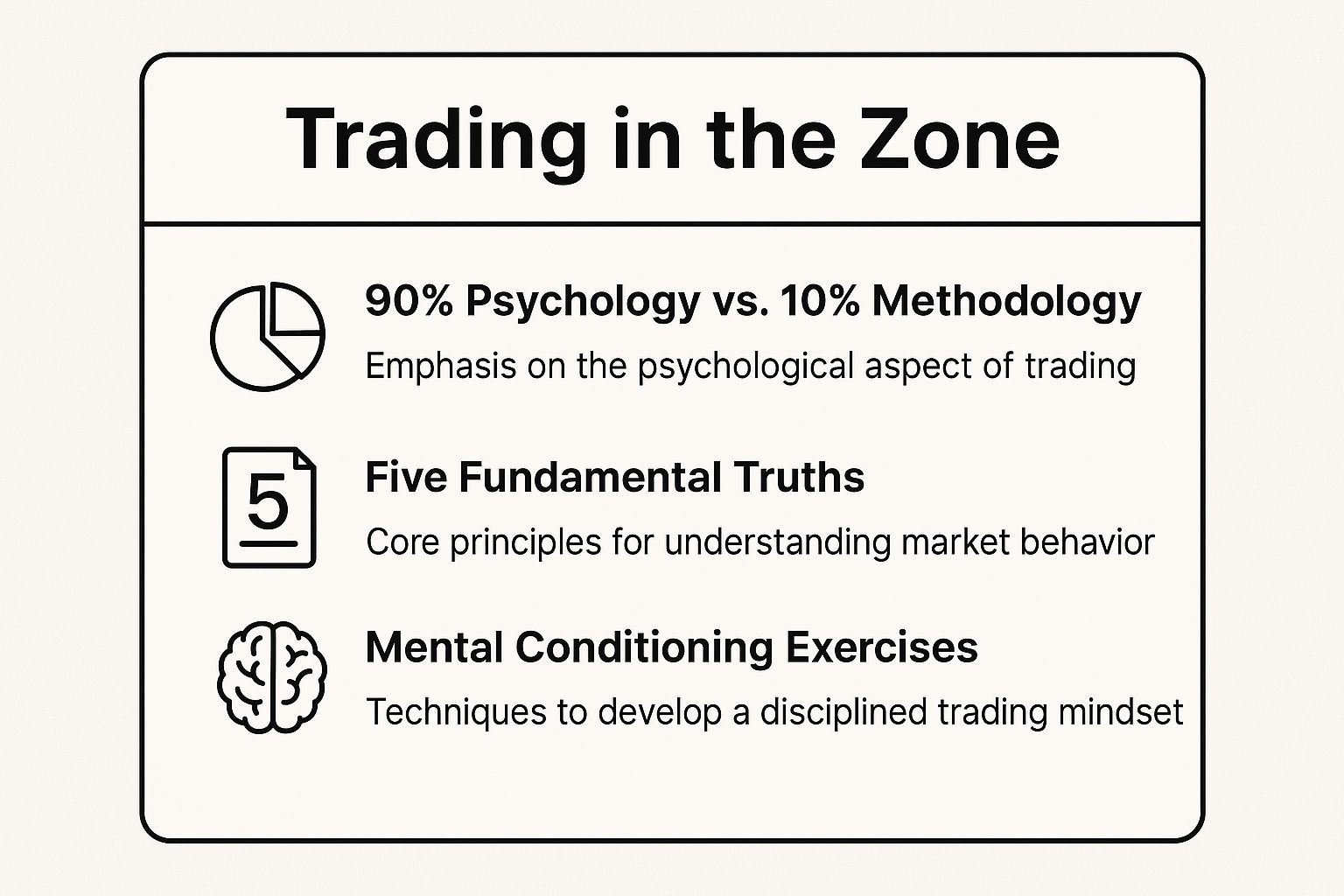
This summary highlights the book’s emphasis on mindset over strategy and provides a structured path for traders to condition their minds for probabilistic thinking.
Practical Tips for Application
- Focus on process, not outcomes: Concentrate on flawless execution of your trading plan, regardless of whether a trade wins or loses. The only thing you can control is your own action.
- Practice mindset exercises: Douglas provides specific exercises in the book. Practice them daily until they become second nature, much like an athlete practices drills.
- Develop a pre-market routine: Use the time before the market opens to reinforce your probabilistic beliefs and review your trading rules, setting a neutral, objective tone for the day.
2. Market Wizards by Jack Schwager
While not exclusively a psychology book, Market Wizards by Jack Schwager earns its place on this list by offering an unparalleled look into the minds of the world’s most successful traders. Through a series of compelling interviews, Schwager uncovers the mental frameworks, risk management philosophies, and psychological discipline that propelled these individuals to legendary status. The book reveals that while their strategies varied wildly, their core psychological principles—like patience, discipline, and emotional control—were remarkably similar.
This collection of interviews is powerful because it moves beyond theory and into real-world application. Readers learn directly from traders like Paul Tudor Jones, who masterfully managed risk during market crashes, and Ed Seykota, whose unwavering discipline in following his system is a lesson in itself. The book’s core value lies in demonstrating that extraordinary success is rooted in a superior mindset, not a secret formula. It’s a journey of long-term commitment, not a get-rich-quick scheme.

Core Concepts and Implementation
The primary lesson from Market Wizards is that there is no single right way to trade, but there are common psychological traits shared by all great traders: discipline, patience, a rigorous approach to risk management, and supreme confidence in their edge. For instance, Michael Marcus’s story of losing everything before becoming wildly successful highlights the critical importance of resilience and the ability to cut losses quickly without emotional attachment. This isn’t about being fearless; it’s about having a plan for losses and executing it without hesitation.
Traders can implement these lessons by identifying the psychological traits they most need to develop. If discipline is a weakness, studying the mechanical, unemotional approach of Richard Dennis and the Turtle Traders provides a clear model. By analyzing these diverse perspectives, you can begin to construct your own trading philosophy, taking inspiration from those who have already navigated the market’s mental minefield. This book is a masterclass in how top performers think, making it one of the most practical books about trading psychology available.
Practical Tips for Application
- Identify common threads: As you read, take notes on the psychological traits and risk rules that appear across multiple interviews, regardless of the trader’s market or style.
- Model their mindsets: Choose one or two traders whose philosophies resonate with you and try to model their approach to risk, discipline, and market analysis.
- Develop your own philosophy: Use the book as a catalyst to write down your own core trading beliefs, rules, and psychological principles.
- Focus on risk management: Pay close attention to how each trader discusses managing losses. This is often the most valuable and universally applicable wisdom in the book.
3. The Psychology of Trading by Brett N. Steenbarger
Authored by a clinical psychologist and active trader, The Psychology of Trading by Brett N. Steenbarger offers a unique, therapeutic approach to mastering the mental game. This book stands out by framing trading challenges as psychological patterns that can be identified, understood, and systematically resolved. Steenbarger provides a structured framework for traders to become their own therapists, applying clinical psychology principles to improve performance. His work is less about abstract philosophy and more about a diagnostic and prescriptive process for overcoming mental hurdles.
The book delves into how emotional responses, ingrained behavioral patterns, and cognitive biases (mental shortcuts that can lead to errors) directly sabotage trading outcomes. Steenbarger moves beyond simply telling traders to “be disciplined” and instead provides the psychological tools necessary to build that discipline from the ground up. For example, he demonstrates that issues like fear of missing out (FOMO) or impulsive decision-making are not just bad habits but symptoms of deeper psychological conflicts that can be addressed with specific therapeutic techniques. This approach empowers traders to diagnose the root cause of their errors rather than just treating the symptoms.
Core Concepts and Implementation
Steenbarger introduces cognitive-behavioral techniques, such as cognitive restructuring and emotional regulation, tailored specifically for the high-pressure trading environment. The book is structured to help traders create a “business plan for the mind,” treating psychological development with the same seriousness as strategy development. A key concept is the idea of “emotional sequencing,” where traders learn to recognize the early triggers of destructive emotions—like the tension in your shoulders before an impulsive trade—and intervene before they take control.
Professional trading firms have adopted Steenbarger’s methods to screen and train their traders, recognizing that psychological resilience is a key differentiator for success. Traders use his self-assessment tools to identify their unique psychological vulnerabilities, such as a tendency toward perfectionism or anxiety, and then apply targeted exercises to mitigate their impact. One practical application is creating a “psychological trading journal” to document not just trades, but the thoughts and feelings preceding and following them, which helps in identifying recurring self-sabotaging patterns.
Practical Tips for Application
- Be your own therapist: Use the self-assessment questionnaires in the book to honestly diagnose your psychological weak spots.
- Practice cognitive reframing: When you experience a negative thought (“I’m a terrible trader”), consciously challenge and reframe it with a more constructive one (“This loss is a learning opportunity and part of my long-term plan”).
- Develop solution-focused briefs: Before each trading day, write down one specific psychological goal (e.g., “I will wait for my setup without exception”) and one specific technique to achieve it.
- Journal emotions: Log thoughts before and after trades — see what is a trading journal for fields to capture.
4. Reminiscences of a Stock Operator by Edwin Lefèvre
Considered a timeless classic, Reminiscences of a Stock Operator by Edwin Lefèvre is a fictionalized biography chronicling the life of the legendary speculator Jesse Livermore. Published in 1923, its lessons on market dynamics and trader psychology are remarkably relevant today. The book is less of a “how-to” guide and more of a narrative that reveals profound psychological truths through Livermore’s spectacular rises and devastating falls. It offers empathy for the trader’s journey, showing that even the greats face immense struggles.
The narrative format makes this one of the most engaging books about trading psychology. It illustrates how even a brilliant market mind can be his own worst enemy. Livermore’s story is a powerful cautionary tale about the dangers of ego, impatience, and breaking one’s own rules. Readers witness firsthand how emotional decisions, like deviating from a proven strategy out of boredom or greed, consistently lead to disaster, even for a market wizard. This long-term perspective is crucial for understanding that discipline is a marathon, not a sprint.
Core Concepts and Implementation
The book’s power lies in its storytelling, which vividly demonstrates the psychological principles that govern both markets and the people who trade them. Key concepts include the importance of market timing, the art of letting profits run while cutting losses short, and understanding crowd psychology. Lefèvre, through Livermore, teaches that markets are driven by human emotions, and recognizing patterns in fear and greed is a trader’s greatest asset.
Traders can implement these lessons by studying Livermore’s thought processes during his biggest trades. For example, his discipline in holding a massive short position through the 1907 panic showcases the psychological fortitude required to trust one’s analysis against overwhelming market noise. To apply this, a modern trader can practice patience by setting profit targets based on market structure rather than emotional impulse, refusing to exit a winning trade prematurely just to lock in a small gain.
Practical Tips for Application
- Learn from both wins and losses: Analyze Livermore’s mistakes, such as his tendency to over-leverage or trade against the main trend, as intently as his successes. His failures offer some of the book’s most valuable lessons.
- Develop situational awareness: Focus on Livermore’s ability to read the “tape” and understand the underlying sentiment of the market. Apply this by paying attention to price action and volume, not just indicators.
- Master patience and discipline: Internalize the famous quote, “It was never my thinking that made the big money for me. It was always my sitting.” Practice waiting for high-probability setups instead of forcing trades out of a need for action.
5. Your Money or Your Life by Vicki Robin and Joe Dominguez
While not a traditional trading book, Your Money or Your Life offers a transformative perspective on the psychology of money that is essential for any trader. The book’s central premise is to reframe your relationship with money by viewing it as “life energy,” which is the time and effort you exchange for it. This philosophy directly challenges the impulsive, often destructive financial decisions that can plague a trading career. It fosters a long-term, disciplined approach to capital preservation.
The authors guide you through a nine-step program to achieve financial independence, which forces you to confront your true motivations and emotional triggers around earning and spending. For traders, this translates into a powerful tool for understanding why they might take on excessive risk, chase losses, or feel overwhelming stress from a drawdown. By calculating the real “life energy” cost of a trading loss, the emotional sting becomes far more tangible than just a number on a screen.
Core Concepts and Implementation
The book’s power lies in making the abstract concept of money concrete and personal. A key exercise is calculating your real hourly wage after accounting for all work-related expenses, from commuting to work attire. This new figure helps you evaluate whether the life energy spent on a losing trade was worth the potential gain. The goal is to align your financial activities, including trading, with your core values and life goals, rather than letting them be driven by short-term greed or fear.
Many traders have used these principles to overhaul their risk management and daily routines. For example, a trader realizing they are risking a week’s worth of “life energy” on a single speculative position is more likely to reduce their size and adhere to stricter stop-losses. This internal shift helps foster discipline by linking trading decisions directly to personal well-being and long-term financial security, making it one of the most practical books about trading psychology available.
Practical Tips for Application
- Calculate your life energy: Determine the true cost of your trading losses by converting them into the hours of life you spent to earn that capital. This reframes risk in a powerful way.
- Align trading with values: Regularly ask yourself if your trading activities and goals are moving you closer to the life you want or just causing stress and taking you further away.
- Create a wall chart: Track your income and expenses visually as the book suggests. This provides a clear, objective look at your financial health and progress, removing emotion from the equation.
- Practice conscious spending: Apply the book’s principles of mindful spending to your trading expenses, such as platforms, data feeds, and educational resources, to ensure they provide real value.
6. The Mental Game of Trading by Jared Tendler
Drawing from his extensive experience as a mental game coach for top-tier poker players and traders, Jared Tendler offers a highly structured and systematic approach to mastering trading psychology. The Mental Game of Trading is not about abstract philosophies; it provides a concrete framework for identifying, analyzing, and resolving the specific mental and emotional issues that sabotage performance. Tendler argues that emotional issues like fear, greed, and anger are not character flaws but rather performance leaks that can be systematically plugged.
The book introduces a practical methodology for mapping your unique mental game problems. Tendler’s approach treats psychological improvement as a skill that can be developed through deliberate, long-term practice, much like technical analysis or strategy development. He provides a step-by-step process for traders to become their own mental game coaches, moving beyond simply coping with emotions to fundamentally resolving the root causes of their destructive trading patterns. This makes it one of the most actionable books about trading psychology available.
Core Concepts and Implementation
Tendler’s system is built around a proprietary model for analyzing and fixing mental game issues. He guides readers to build a “mental hand history” to pinpoint the exact triggers for flawed decision-making, such as tilting after a loss or cutting winners short out of fear. The goal is to move from unconscious incompetence, where you don’t even know why you’re making mistakes, to conscious competence, where you can actively manage your mental state.
For example, a trader struggling with revenge trading can use Tendler’s framework to identify the underlying emotion, whether it’s anger, injustice, or a need to “get even” with the market. By working through the book’s exercises, they can develop a strategic plan to correct this behavior. A critical component of this process involves integrating robust risk management protocols, which you can learn more about in this guide covering 9 proven risk management techniques. This creates a support structure that contains emotional impulses while you work on rewiring your mental responses.
Key Takeaways from the Book
The book provides a clear roadmap to diagnose your personal mental game flaws and build a strategy to correct them. It emphasizes that consistent performance is impossible until you resolve the emotional interference that prevents you from executing your plan flawlessly. Tendler’s core message is that peak performance is achievable through a structured and disciplined approach to psychological training over the long haul.
Practical Tips for Application
- Create a mental game profile: Use the book’s worksheets to map out your patterns of fear, greed, anger, and confidence issues. Be honest with yourself about your struggles.
- Practice strategic injections of logic: When you feel a destructive emotion rising, use a pre-planned logical statement (e.g., “This one trade doesn’t define my career”) to interrupt the pattern and regain control.
- Develop a warm-up routine: Before each trading session, spend a few minutes reviewing your mental game goals and common pitfalls to prepare your mind for the day.
- Keep a detailed mental game journal: Track not just your trades, but your emotional state and thought processes to gather data on your psychological patterns.
7. Thinking, Fast and Slow by Daniel Kahneman
While not written exclusively for traders, Nobel laureate Daniel Kahneman’s Thinking, Fast and Slow is an indispensable resource for understanding the cognitive machinery that drives financial decisions. Kahneman introduces the dual-process model of the brain: “System 1” (fast, intuitive, emotional) and “System 2” (slow, deliberate, logical). The central argument is that our reliance on the effortless System 1 leads to predictable errors in judgment, known as cognitive biases, which can be disastrous in the trading arena.

The book provides a profound framework for recognizing why traders instinctively make poor choices under pressure. It explains the mechanics behind biases like loss aversion (feeling the pain of a loss more than the pleasure of an equal gain), the anchoring effect (relying too heavily on the first piece of information), and overconfidence. By understanding these inherent mental flaws, traders can begin to construct processes to counteract them, making this one of the most important books about trading psychology available for fostering long-term discipline.
Core Concepts and Implementation
The primary goal for a trader reading this book is to learn how to engage the deliberate and analytical System 2 when making trading decisions, rather than succumbing to the quick, biased reactions of System 1. This means moving from “gut feel” trading to a rules-based, systematic approach that mitigates emotional and cognitive errors.
For example, a trader suffering from loss aversion might hold a losing stock for far too long, hoping it will turn around, because the pain of realizing the loss is too great. By recognizing this bias, they can implement a hard, non-negotiable stop-loss rule—a System 2 override. Similarly, by understanding the availability heuristic (overestimating the likelihood of events that are more easily recalled), a trader can avoid chasing a hot stock just because it’s all over the news. Instead, they can force themselves to perform objective analysis based on their established trading plan.
Practical Tips for Application
- Create a bias checklist: List the cognitive biases described in the book (e.g., confirmation bias, anchoring, hindsight bias) and review your trading journal to see which ones affect you most.
- Develop System 2 processes: Build and strictly follow rule-based systems for entries, exits, and risk management. This forces logical thinking and reduces impulsive System 1 decisions.
- Introduce cooling-off periods: If you experience a large loss or a string of losses, step away from the screen. This prevents System 1 from making emotional decisions like revenge trading.
- Question your certainty: Before placing a trade, actively challenge your own assumptions. Ask, “What if I’m wrong?” and “What information might I be ignoring?” This engages System 2 and combats overconfidence.
8. The Disciplined Trader by Mark Douglas
As Mark Douglas’s earlier work, The Disciplined Trader lays the essential groundwork for the concepts later refined in his more famous book, Trading in the Zone. It’s a deep dive into the psychological challenges that derail aspiring traders. Douglas’s central premise is that our ingrained beliefs and emotional responses, shaped by everyday life, are completely counterproductive in the market environment. He meticulously dissects the mental transition a person must undergo to succeed, offering empathy for the common struggles traders face.
This book is less of a quick read and more of a foundational study on building the mental architecture required for consistent, long-term performance. It focuses on how to develop the specific discipline needed to operate effectively in an arena where you are solely responsible for your results. The goal is to move from a state of emotional chaos, characterized by fear and greed, to one of objective, mechanical execution. It provides a structured approach to identifying and overcoming the mental roadblocks that prevent traders from trusting their systems and themselves.
Core Concepts and Implementation
The Disciplined Trader is about deconstructing your existing mental framework and rebuilding it for trading. Douglas explains why traditional goal-setting and emotional responses lead to failure. He emphasizes the need to accept risk fully and separate one’s self-esteem from the outcome of any single trade. The book is structured to guide the reader through a process of self-discovery and mental reprogramming.
For example, traders have used its principles to create rigid pre-market routines that reinforce objective thinking before a single trade is placed. A practical application would be writing down your rules each morning and affirming your commitment to follow them regardless of the outcome. Others have implemented its lessons to analyze their trades without emotional attachment, focusing solely on whether they followed their rules, not on the profit or loss. This separation of ego from trading decisions is a cornerstone of the book and a crucial step toward becoming a truly disciplined trader.
Key Takeaways from the Book
The book provides a systematic guide to developing the mindset of a successful trader. It addresses the fundamental conflicts between how we think in normal life and how we must think to trade effectively. This makes it one of the essential books about trading psychology for anyone serious about mastering their inner game. The core message is that without mental discipline, even the best trading strategy is doomed to fail over the long run.
Practical Tips for Application
- Develop daily mental discipline: Practice the mental exercises in the book daily. Consistency is key to rewiring your ingrained emotional responses to the market.
- Eliminate fear and greed: Work on creating objective, rule-based criteria for every trade entry, exit, and stop-loss placement to minimize emotional interference.
- Separate ego from outcomes: Judge your performance on your ability to follow your plan flawlessly, not on whether an individual trade was a winner or loser.
- Practice objective analysis: Review your trades based on your execution of the plan, not the monetary result. This builds the habit of process-oriented thinking.
Top 8 trading psychology books compared
| Book | Core focus | Best for |
|---|---|---|
| Trading in the Zone | Probabilistic thinking, accepting risk | All traders; foundational mindset |
| Market Wizards | Interviews, discipline, risk rules | Intermediate+ seeking role models |
| The Psychology of Trading | Clinical tools, CBT-style exercises | Traders who want structured self-diagnosis |
| Reminiscences of a Stock Operator | Narrative lessons on ego and patience | Readers who learn through story |
| Your Money or Your Life | Money mindset, life-energy framing | Traders linking risk to personal values |
| The Mental Game of Trading | Tilt, leaks, corrective routines | Active tilters and repeat rule-breakers |
| Thinking, Fast and Slow | Cognitive biases, System 1 vs 2 | Anyone fixing impulsive decisions |
| The Disciplined Trader | Fear, greed, rule-based execution | Beginners before Trading in the Zone |
From reading to action: build your mental edge
Reading alone does not change results. Pick one psychological leak (revenge trading, early exits, oversizing) and work it for 30 days while you journal.
Pre-trade and post-trade ritual
Before entries:
- Am I in a neutral emotional state? (The Disciplined Trader)
- Does this trade match my plan, or is it impulse? (The Mental Game of Trading)
- Have I accepted the risk on this trade? (Trading in the Zone)
After the session, review process, not just P&L: rules followed, hesitation, urge to “make it back.” Tag emotions in your journal so patterns show up in data — not just memory.
Log psychology in your journal
Fields worth tracking every session:
- Emotional state (calm, anxious, revenge, FOMO)
- Rule compliance (yes/no per trade)
- One sentence: what triggered the mistake or best decision
TraderSetup and similar tools let you filter by tags over time — e.g. “revenge” trades vs baseline win rate.
Related reading
- Why every trader needs a trading journal — apply book lessons daily
- What is a trading journal — what to record
- Risk management for traders — contain emotions with rules
- Best books for day trading beginners — technical and platform skills
- Journaling for beginners — build the review habit
Start journaling with TraderSetup for free — connect mindset to your results.